Case study · AI + Financial Services
Conversational AI Agent
How research with Relationship Managers reshaped the roadmap and transformed separate agents into a unified experience at Itaú Private Bank.
Context
The problem was not a lack of information. It was the effort required to reach it.
The day-to-day work of Itaú Private’s Relationship Managers (RMs) is highly operational. Queries, tasks and requests are spread across different systems, some of them with limited modernization and inconsistent governance. Low automation increases manual work, creates long paths and raises operational risk in journeys that can directly affect Private Bank clients.
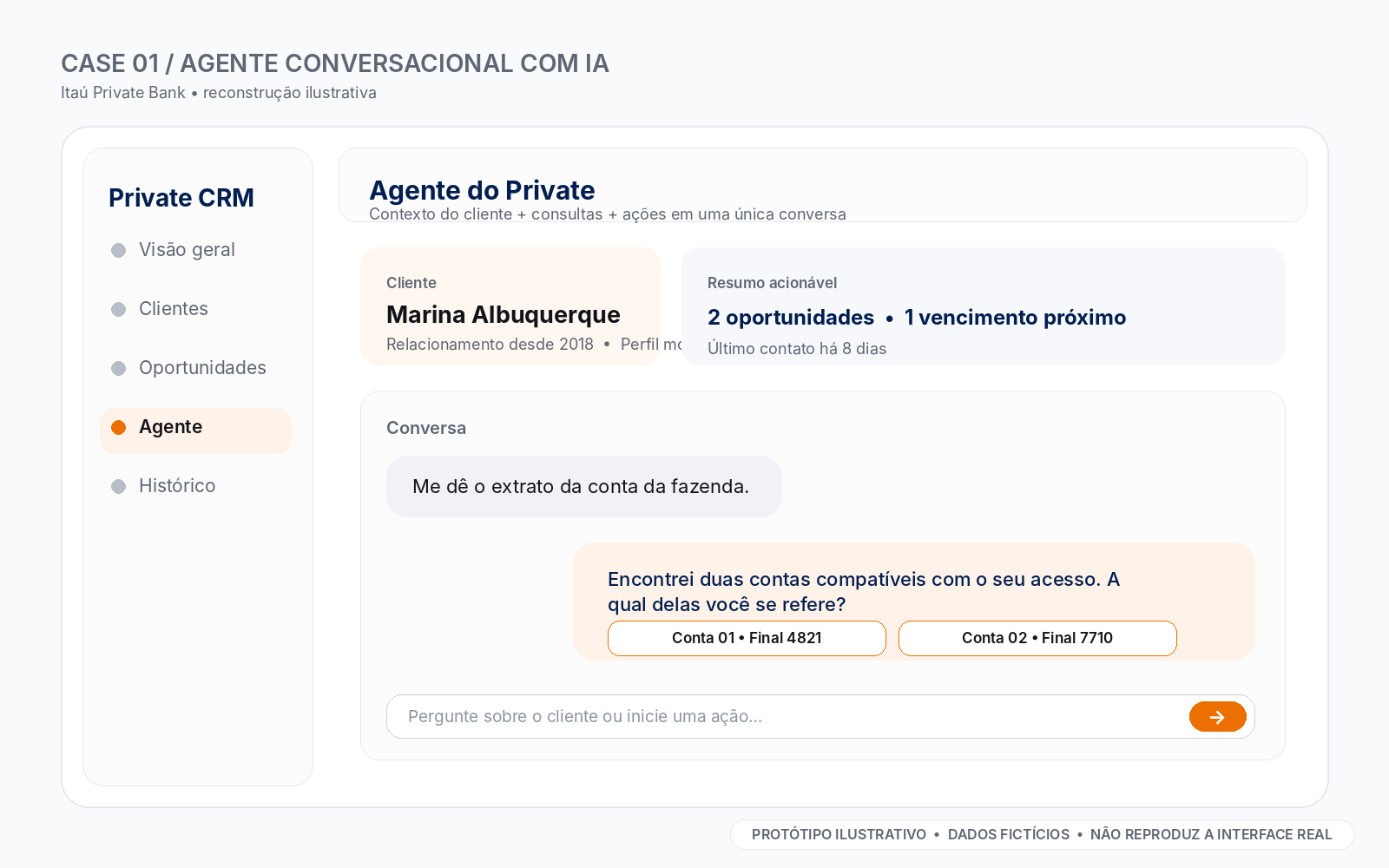
The agent emerged as a way to relieve the commercial team’s workload: instead of moving through several routes, screens and systems to find information, an RM could express a need in natural language and let the experience orchestrate the complexity behind the scenes.
“The goal was not to create another place for RMs to work. It was to reduce the number of places they needed to understand in order to get work done.”
Product goals
- Reduce the effort required to retrieve information and navigate systems.
- Decrease manual work and reliance on long navigation paths.
- Preserve context throughout the conversation.
- Avoid unsupported assumptions in ambiguous situations.
- Support RMs with suggestions and next steps.
- Evolve from information retrieval to transactional capabilities.
Discovery
Before designing the conversation, we understood the work behind it.
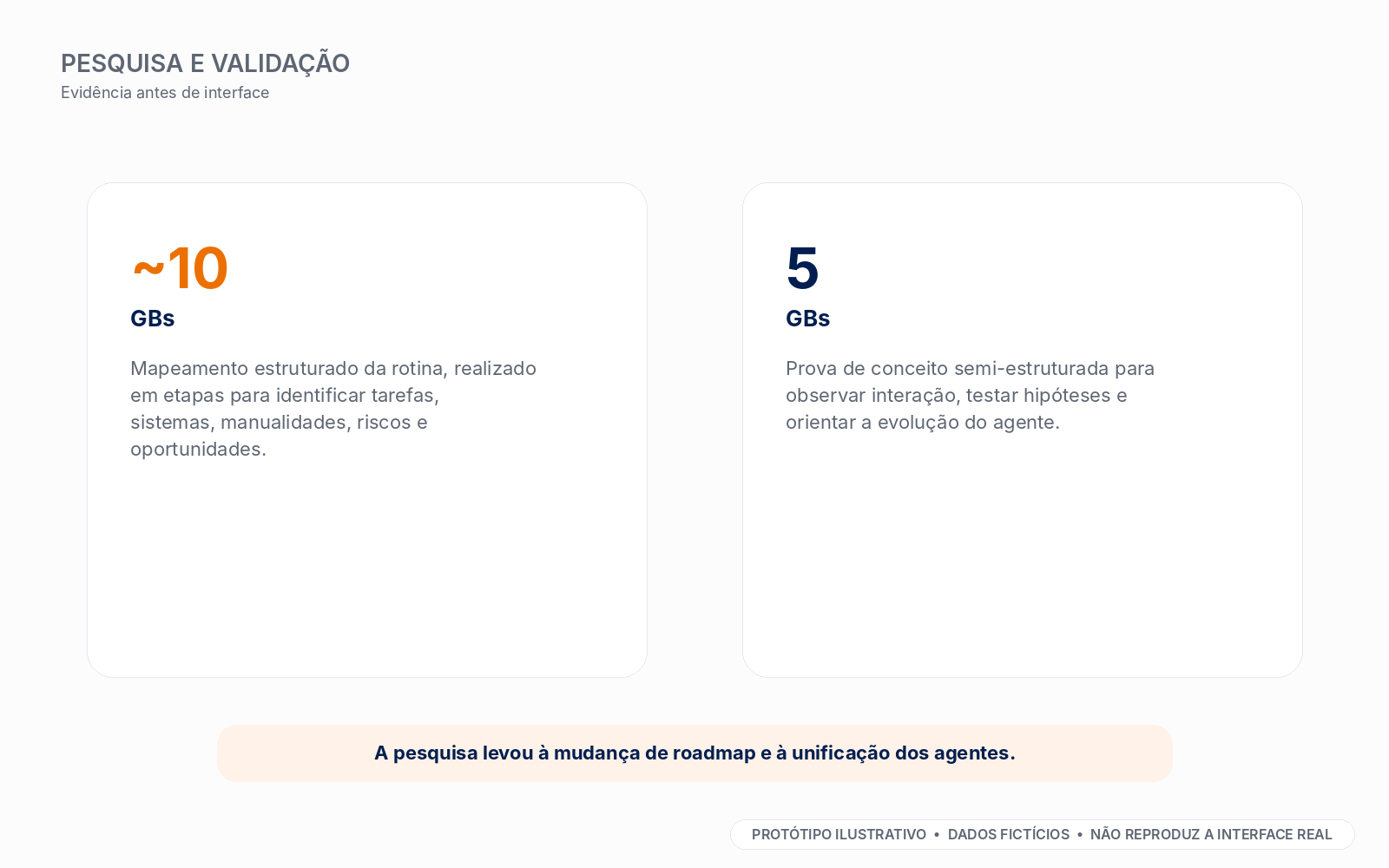
I led a structured mapping of the RMs’ routine, investigating tasks, systems, manual work, friction points, risks and opportunities to reduce operational load. This effort involved approximately 10 professionals.
We then ran a semi-structured proof of concept with 5 RMs. The goal was to observe how users understood the proposition, which information they considered insufficient, where ambiguity emerged and which hypotheses needed to be revised.
My contribution
I led discovery, research, hypothesis definition, experience architecture, flows, prototyping, the proof of concept, synthesis of learnings, decision presentations and advocacy with stakeholders, alignment with PM and engineering, and handoff documentation.
The conversational experience was built in close partnership with Content Design. For the interface, we used Itaú’s official Design System rather than creating a parallel system.
Strategic decision
The POC started with two agents. Research showed that users needed one.
The initial proposal separated the new AI agent from the transactional agent connected to WhatsApp. This architecture guided the first steps of the proof of concept.
User conversations showed that the separation did not reflect how RMs understood their work. They should not need to know which agent, technology or capability sits behind each request. Fragmentation also broke conversational continuity.
I presented the evidence to the team and advocated for a unified experience. The direction was incorporated into the roadmap: different agents should behave as a single point of contact from the user’s perspective, preserving context and continuity regardless of which capability is triggered behind the scenes.
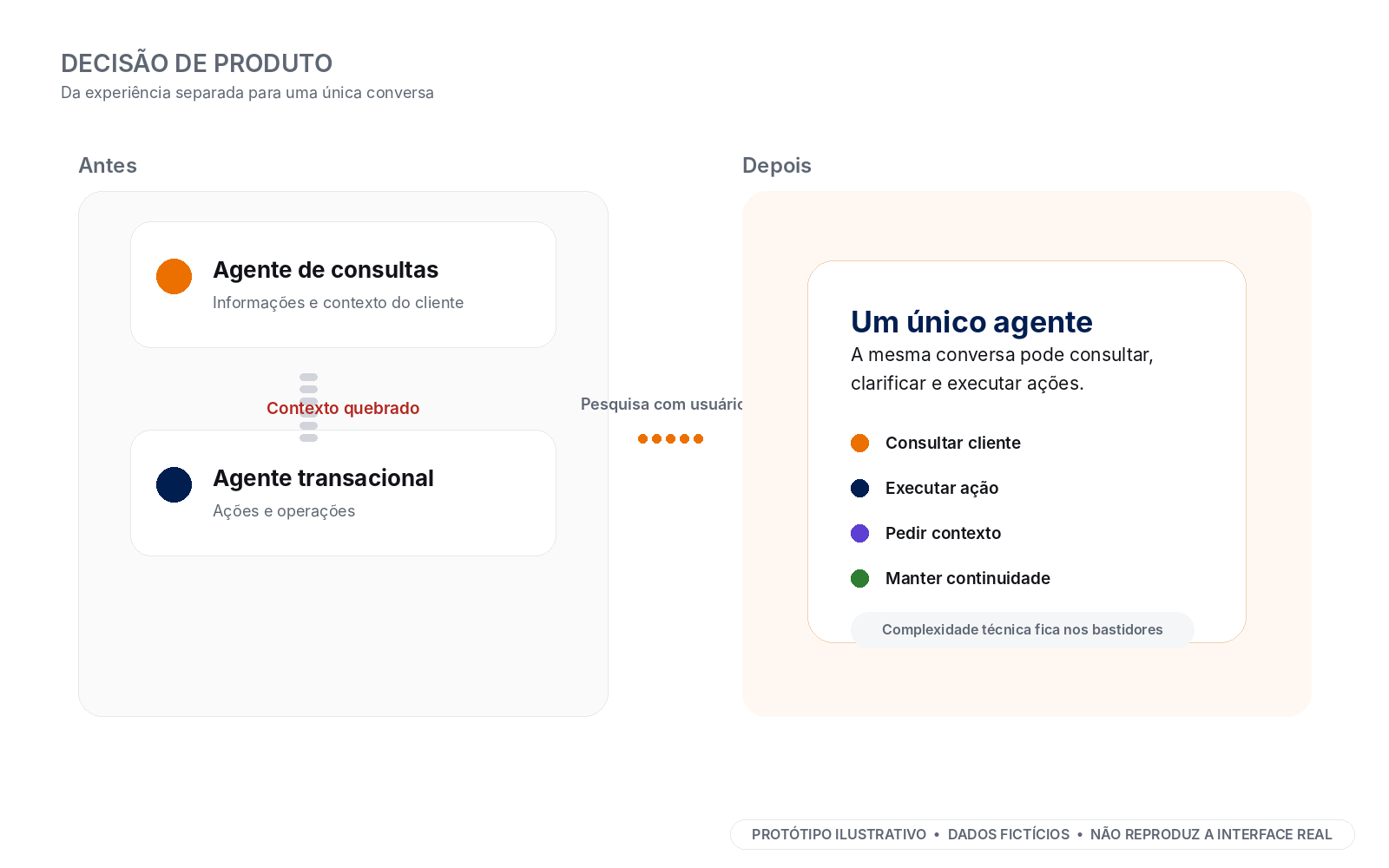
Design’s impact here was not a screen. It was a change to the experience architecture and the product roadmap.
AI + context
Not every important piece of context exists in the bank’s databases.
The proof of concept revealed a significant limitation: part of the context RMs use in client relationships is informal and built over time. It may not exist in any structured database.
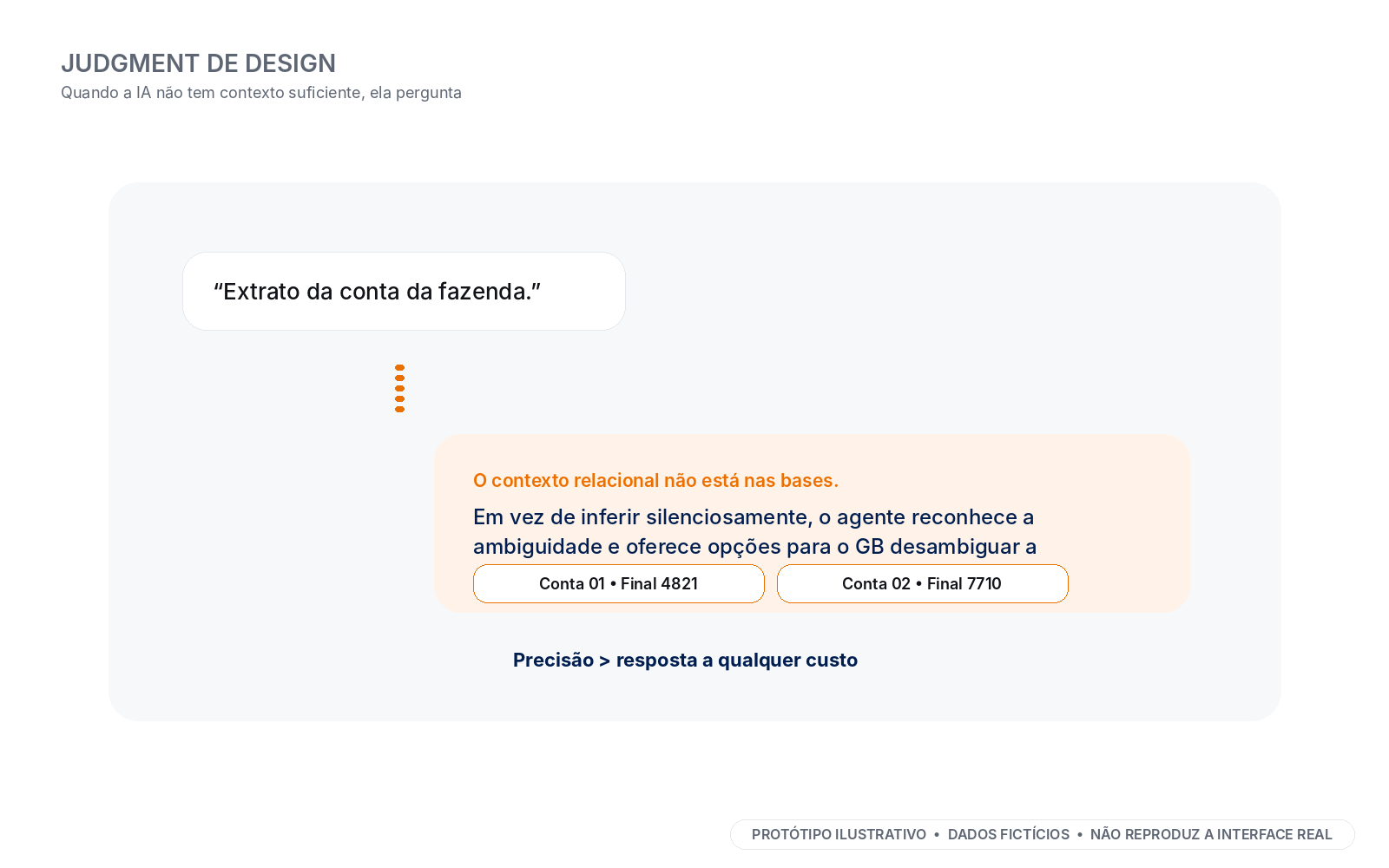
One example was a request such as “show me the statement for the farm account.” To an RM, “farm account” may refer to a specific account established through the history of the relationship. The agent does not necessarily have that association.
Experience decision
When ambiguity exists, the agent must not make a silent assumption. It should acknowledge the missing context, present matching options and ask the RM to disambiguate the request before proceeding.
Proactivity
The agent also turns conversations into actionable requests.
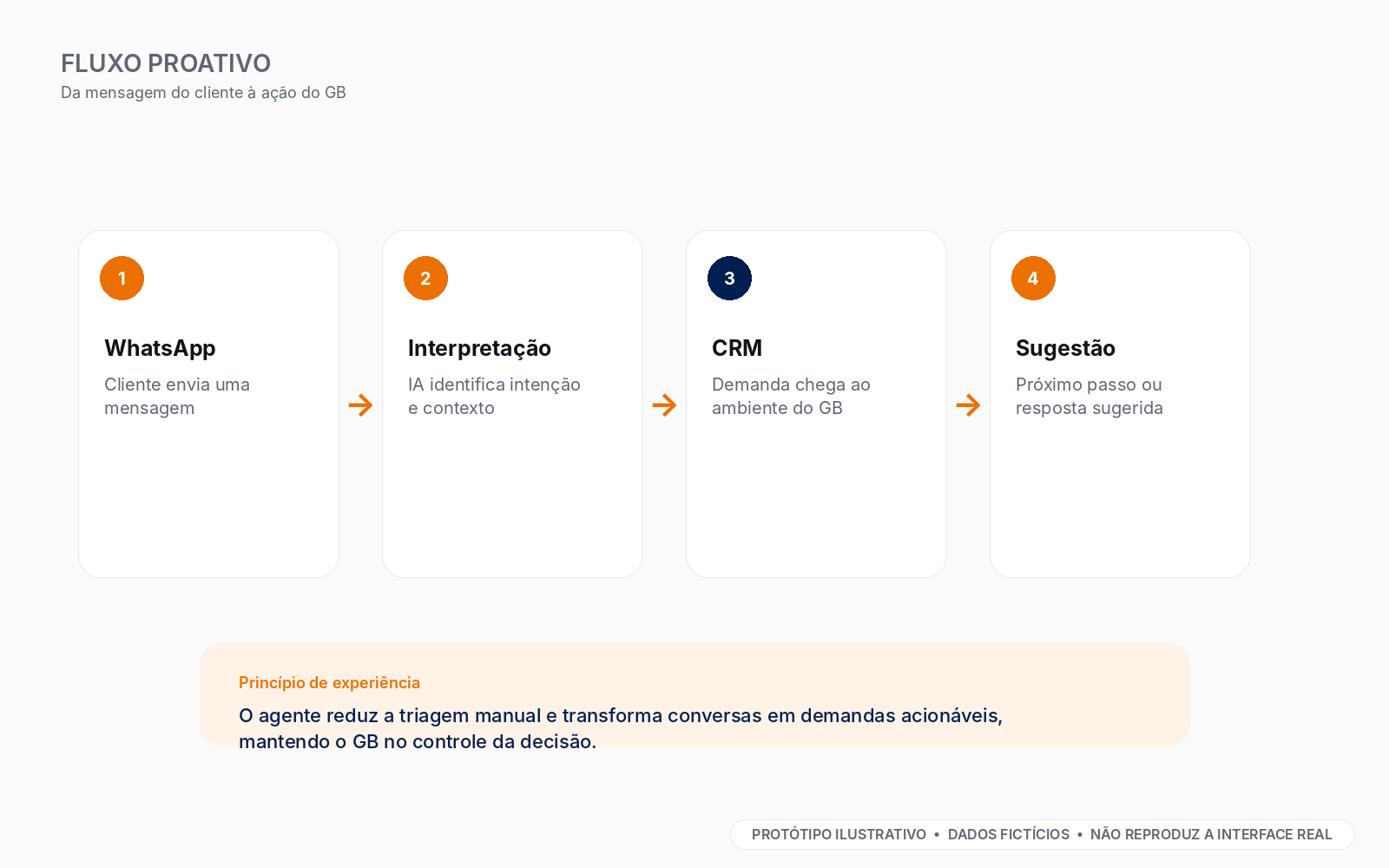
The product vision goes beyond answering questions. In proactive flows, a client’s WhatsApp message can be interpreted by the agent, have its intent identified and reach the CRM with context, a suggested action or a proposed reply for the RM to review.
What this changes in the routine
- Reduces manual triage of messages and requests.
- Brings context into the environment where RMs already work.
- Supports the commercial team without removing control over decisions.
- Creates a foundation for a more continuous experience across communication, CRM and execution.
AI in the Design process
AI as a product — and as a work tool.
In addition to designing an AI-powered experience, I used Microsoft Copilot to support the Design process. It helped accelerate operational tasks, always paired with critical review and human decision-making.
Research
Support with planning, interview guide structure and session preparation.
Synthesis
Organization and compilation of findings to make comparison and review easier.
Prototyping
Faster exploration of alternatives and rapid prototypes to validate hypotheses earlier.
Handoff
Support in structuring clearer documentation for engineering and stakeholders.
Results and stage
What changed — and what is still evolving.
- The client information retrieval agent is already available in production.
- The transactional capability is still in proof of concept.
- Research changed the roadmap and consolidated the vision of a single agent.
- Information retrieval paths are expected to become faster and less dependent on manual navigation.
- Estimated impact of approximately 11 percentage points in reducing the RM’s workload.
Time saved, adoption rate, NPS and click reduction have not yet been consolidated, so they are not presented as results.